

If you sponsored a self-insured or level-funded plan, including an HRA, with a plan year beginning on or after February 1, 2021, keep reading!

What is the PCORI fee?
The Patient-Centered Outcomes Research Institute (PCORI) fee is a fee that plans are required to pay to fund research on the comparative effectiveness of medical treatments. Essentially, every covered life on a medical plan has a value earmarked for such research funding every year.
Are any plans exempted from paying the PCORI fee?
Yes, but the general rule is if you are sponsoring a major medical plan that covers individuals living in the United States, you are subject to the PCORI fee. This includes tax-exempt and ERISA-exempt plans. These are the limited exceptions:
- Plans that are designed to cover employees who are working and residing outside the United States
- Dental and vision plans, known as excepted benefits
- Employee assistance programs (EAPs)
- Wellness and disease management programs
Who Pays the PCORI Fee?
- For fully insured plans, the fee is paid by the carriers.
- For employers sponsoring self-insured or level-funded plans, the Employer / Plan Sponsor pays the fee.
- For employers sponsoring a Health Reimbursement Account (HRA) integrated with a fully insured plan, the Employer / Plan Sponsor pays the fee for the HRA (self-funded plan) and the carrier pays the fee on the major medical plan.
The Employer / Plan Sponsor is responsible for reporting the PCORI fee on the self-insured plan. This is not something that can be delegated to another entity.
When is the PCORI Fee due?
The PCORI fee is due no later than July 31 of the year following the year in which the plan ends. This is why employers sponsoring non-calendar year self-insured plans renewing in 2021 have a reporting obligation July 31, 2023. It’s easy to forget! Here’s a non-calendar year and calendar year example:
| Plan Year: | February 1, 2021 to January 31, 2022. |
| PCORI Due: | July 31, 2023 – the year following the year the plan ends. |
Calendar-year plans (1.1 – 12.31) that renewed January 1, 2022 report their fee no later than July 31, 2023.
| Plan Year: | January 1, 2022 to December 31, 2022 |
| PCORI Due: | July 31, 2023 – the year following the year the plan ends. |
What is the policy year / plan year?
Generally, the policy / plan year is the 12-month period of medical coverage. There are nuances, so feel free to reach out to me with questions.
Why is the Plan Year relevant?
It matters because the PCORI fee is an indexed amount that is determined by the last day of your plan / policy year.
What if we had a short plan year in 2021 or 2022?
The PCORI fee applies to a short plan year, and the employer is responsible for paying the PCORI fee on the short plan year if the plan was self-insured. Here’s an example:
- Employer sponsored self-insured medical plan that ran on a non-calendar year basis, July 1 to June 30.
- In 2022, Employer moved the plan to a calendar year to line up with its Cafeteria Plan year. The plan had a short plan year of July 1, 2022 to December 31, 2022.
- For this PCORI reporting cycle, Employer has two plan years for which to account:
- July 1, 2021 to June 30, 2022
- July 1, 2022 to December 31, 2022
How much is the PCORI Fee?
Generally, the PCORI fee is calculated by multiplying the average number of covered lives (“belly buttons”) on the self-insured medical plan by $2.00 indexed. The indexed amounts for this reporting period are:
- $2.79 for plans that ended on or after October 1, 2021, and before October 1, 2022
- $3.00 for plans that ended on or after October 1, 2022 through December 31, 2022
Using our example above:
- Original Plan Year Fee: July 1, 2021 to June 30, 2022 → $2.79 per covered life
- Short Plan Year Fee: July 1, 2022 to December 31, 2022 → $3.00 per covered life
What if we sponsor a self-insured medical plan, prescription plan, and an HRA?
If the employer sponsors multiple self-insured plans (i.e., medical, prescription drugs, an HRA), this can be treated as one plan for purposes of calculating the PCORI fee.
What if we sponsor a fully insured medical plan with an integrated HRA?
There is a special rule for HRAs that are paired with a fully insured medical plan. Remember, the carrier is paying the PCORI fee on the fully insured plan. You have
How do we determine the average number of “covered lives”?
There are three methods available to determine the number of covered lives, which is reported on the Form 720. They are:
- Actual Count: Add the total number of lives covered for each day of the first nine months of the plan year and divide that total by the number of days in the first nine months.
- Snapshot Count: Add the total number of lives covered on any date during the same corresponding month in each of the first three quarters of the plan year, and divide that total by the number of dates on which a count was made.
- Form 5500 Method: Add the number of participants on the first day of the plan year and the last day of the plan year as reported on Form 5500 and divide by 2. This method can only be used if you file a Form 5500 that covers the applicable reporting period and if that Form 5500 was filed timely.
The goal is to use the calculation method that results in the smallest number thereby reducing the PCORI fee.
Are COBRA Qualified Beneficiaries included in the covered lives calculation?
How is the PCORI fee reported?
The PCORI fee is reported in Part II, line 133, of Form 720, found here. The updated Form 720 (rev. June 2023) contains the applicable indexed fee amounts of $2.79 for plans that ended on or after October 1, 2021, and before October 1, 2022, and $3.00 for plans that ended on or after October 1, 2022 through December 31, 2022. Yes, it goes to October 1, 2023, but plans ending in 2023 aren’t yet reporting or paying the PCORI fee.
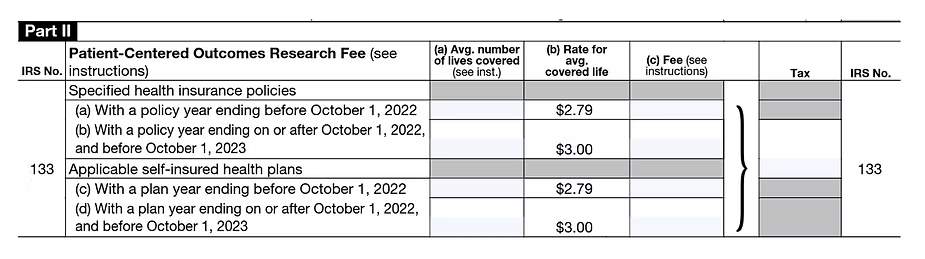
How is the PCORI Fee paid?
Deposits aren’t required for this fee, so employers aren’t required to pay the fee using EFTPS. However, if the fee is paid using EFTPS, the payment should be applied to the second quarter.
Is the PCORI Fee deductible?
Yes. The PCORI fee is deductible under the Internal Revenue Code section 162.
What kind of documentation should an Employer keep?
The IRS may request records substantiating the PCORI fee going back four years from the date of the last payment. Another agency involved in PCORI, the U.S. Department of Health and Human Services (HHS), can go back 10 years for records pertaining to employee counts and fees.
What happens if a payment was missed?
Employers responsible for fee payments are subject to the PCORI fee plus an excise tax ranging from 5% of the PCORI fee up to 25% of the fee.
What if we still have questions?
I am happy to address any questions you may have. Please reach out via the contact form.